Plain-language summary:
As expected, rain showers changed to snow showers yesterday evening, mainly over higher elevations with just flurries in the lower elevations. This is especially evident in the satellite imagery today. This winter featured below average snowfall except in northern Maine and parts of Quebec north of Montreal. After some higher-elevation snow in the Adirondacks and southern Vermont and lower-elevation rain tomorrow, northerly wind on the back side of the storm bringing cooler air combined with nighttime cooling could bring a dusting of snow even to lower elevations.
Meteorological discussion:
Yesterday evening, the combination of cold air from the upper-level trough and nighttime cooling led to rain showers changing to snow showers. However, with high Froude numbers implying unblocked flow, along with decreasing moisture, meant that the accumulating snow was almost exclusively over the higher terrain, with Stowe and Jay peaks reporting 6" (15 cm). Since there were few if any clouds west of New Hampshire this morning, this elevation dependence was quite evident on visible satellite:
 |
| Source: GOES-East |
The snow cover in the St. Lawrence Valley north of Montreal is old snow cover, not from last night. That brings me to my next point, which is that there's still a very sharp north-south gradient in snow cover, with amazingly still over 40" (1 m) on the ground in the Laurentians north of Quebec City.
 |
| Source: NOHRSC |
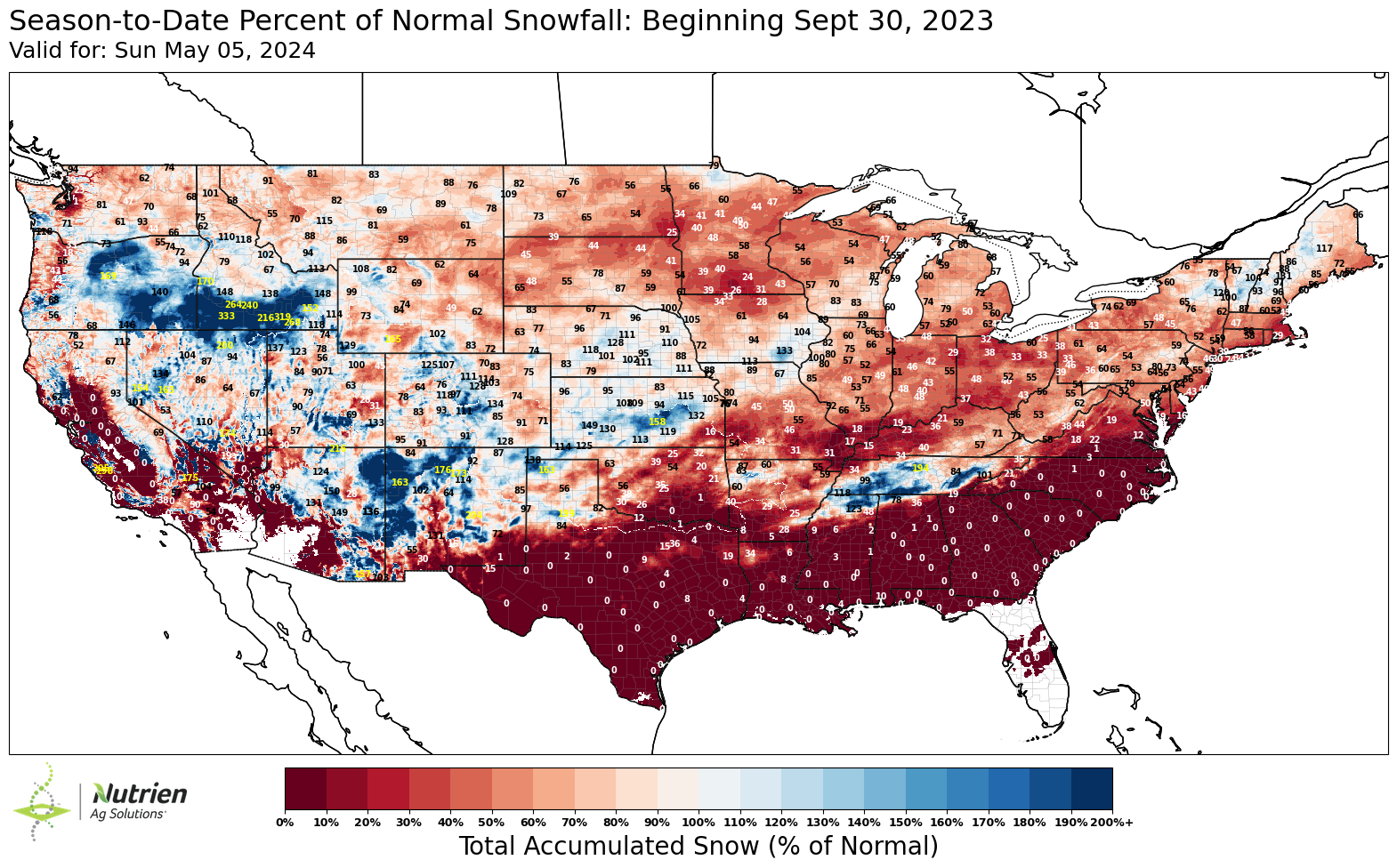
Most of the U.S., including the northeast U.S. (other than northern Maine and isolated locations elsewhere) has had below-average snowfall, despite all the talk about storminess during the winter. December and February featured many storms that were either Alberta Clippers or storms cutting northeastward through the Great Lakes, mostly too far north to bring much if any snow to the northeast U.S., instead bringing rain and/or thaws. However, those same storms brought snow with little thawing to areas north of Montreal repeatedly, where snowfall has been near to above average. This "rich getting richer" pattern led to a pronounced snow cover gradient.
 |
| Source: Ag Solutions |
Another weak system tomorrow, this time passing to the south over Pennsylvania and then off the New Jersey coast, will produce rain showers over lower elevations and snow showers over higher elevations, mostly south of the U.S./Canada border except in eastern Ontario. The higher terrain in New York between the Pennsylvania border and I-90 could see a burst of heavy snow in the morning. Although the surface system is weak, it is associated with a deep, closed circulation up to 500 hPa. The instability with the cold pool could lead to some mixed rain and snow showers in the Laurentians north of Montreal as well. It's not a strong closed-off low at 500 hPa, but funny things happen with closed lows nonetheless. Still, the April sun angle should limit daytime accumulations to >1500 ft (450 m).
 |
| Source: PivotalWeather |
As it slowly strengthens as it moves offshore tomorrow night, it will wrap a bit of Atlantic moisture to the western side of the system as well as some colder air from the north and northeast. Like yesterday, the deep northerly flow will lead to some upslope snow showers over the higher terrain, but this time, the wind will be weaker with less of a westerly component. This means that Froude numbers will be lower, likely leading to light snow showers amounting to <1/2" (1 cm) backing into the eastern St. Lawrence and Champlain Valleys and perhaps in Maine too with less of a downsloping component. Any accumulation in lower elevations will be limited to non-paved surfaces due to marginal surface temperatures. In some areas, mid-level moisture might be lacking a bit, leading to warm cloud tops and a lack of cloud ice, with drizzle or freezing drizzle resulting instead of snow, but I think this will be isolated and any ice accumulation will be negligible.
 |
| Source: PivotalWeather |
No comments:
Post a Comment